Monday, February 1, 2016

Learning How to Learn, Part 4: Renaissance Learning and Unlocking Your Potential

This post is a summary of the final fourth week the Learning How To Learn course at Coursera.

2 Tips for Better Learning from Terry Sejnowsky:

  1. Physical Exercise is by far more effective in helping you learn better than any drug
  2. Recognize critical periods related to learning and be prepared for them. Like first language acquisition is better done before puberty.
Learning does not progress logically, sometimes you hit a wall or get frustrated. It means you mind is wrestling deeply with the material. After emerging from these periods, you'll often find that you learning base has broadened a lot.

Create a Lively Visual Metaphor or Analogy!

Pretend that you are the concept you are trying to understand!

People learn by trying to make sense out of the information they perceive, not from having someone else tell it to them. Greater understanding results from your mind constructed the patterns and meaning.

Genius vs Creativity

Genius and intelligence are associated with a bigger set of working memory, but on the negative side, the ideas may be coming too quickly and may leave no room for better ideas.

People with a smaller working memory are often more creative, because they can more easily come up with an unusual combination of chunks.

Many people suffer from the impostor syndrome. They feel inadequate and are afraid to be found out.

Change your thoughts, change your life

Santiago Ramon y Cahal, a Nobel prize winner, noted that any person (even with average intelligence) can change their own brain (their thought patterns) so even the least capable can produce an abundance of harvest.

Taking responsibility for my learning


I do think I take responsibility for my learning and that I spend a lot of time practicing and studying. However I feel I do not make a lot of progress, perhaps due to lack of proper techniques, or perhaps due to my impatience. I solve problems pretty quickly. I like solving problems a lot, because it gives me a lot of satisfaction. But maybe I should take more time to try to generalize my experience, to form better, more stable chunks of knowledge, to think deeply about analogies and metaphors, discuss with others. 

I've spent so much time trying to learn different things in my life, but I often can't even remember the essence of most of those things, sadly enough.

On the other hand, I have achieved quite a lot in learning: I've mastered several foreign languages, I've had several different jobs in mathematics, telecommunications and software engineering in different subject domains, each with their own sets of concepts to grasp.


The Value of Teamwork


The rest of this final part is about testing.
Testing is a great learning technique:

- Do self-testing
- Check Dr. Felder's test preparation check-list!
- Hard start - jump to easy technique: read through all problems, start with a difficult one, then quickly jump to an easy one, and so forth, back and forth.
- Do 90 seconds of deep breathing before or during the test.
- Double check your answers from a big-picture perspective: does it really make sense?
- Get enough sleep before the test!

Sunday, January 17, 2016

Happiness Week 4: Control vs Personal Responsibility

This fourth post in my series on happiness sums up week 4 of the study course I am following on http://www.coursera.org called A Life of Happiness and Fulfillment:  https://www.coursera.org/learn/happiness
To see all the posts in this series go to http://lublenok.blogspot.com/search/label/ALHF

Week 4 of the course starts with the discussion of the topic of control seeking.

On the one hand, it turns out that people having control over one's life is a very important determinant of psychological and physical health and happiness!

Those with a greater desire for control:
  1. Tend to aim higher in life
  2. Tend to achieve more
On the other hand, we can't control everything all the time. 

Why being overly controlling of other people, lowers our happiness:
  1. Others don't like to be controlled by us. It makes them unhappy, which lowers our own happiness.
  2. It results in anger, frustration and disappointment when others don't behave the way we want them to
  3. Decision-making suffers
Why being overly controlling of outcomes, lowers our happiness:
  1. You are more likely to be frustrated when things don't turn out like you want them to
  2. The quality of your decisions is likely to suffer: superstitions, risk-taking
  3. If we obsess about outcomes, we are likely to sacrifice our health and our relationships
Antidote habit: Taking Personal Responsibility for your Happiness

It's about regulating our emotions and taking control of our feelings

Because our thoughts influence our feelings, we can regulate our feelings by controlling our thoughts

Anger is often preceded by thoughts that something is blocking us from achieving what we want
Sadness is often preceded by thoughts that something valuable is missing or lost
Anxiety is often preceded by thoughts or being uncertain or out of control

Pride is triggered when you attribute success to your actions or skills
Gratitude is triggered when you attribute success to somebody else's actions or luck

The higher the ability for internal control the lower the need for external control

Simple Emotion Regulation Strategies
  1. Situation Selection
  2. Labeling your emotions
  3. Attention deployment
  4. Cognitive reappraisal
Uncertainty and lack of control are important for enjoying life!

Leading a healthier life style:
  1. Eat right
  2. Move more
  3. Sleep well
Remember self-compassion and common humanity

Saturday, January 16, 2016

Learning How to Learn, Part 2: Chunking

The second week of the Learning How To Learn course is about chunking.

Chunking is about forming small mental patterns of meaning relating the material learned to a greater context. These chunks are committed to memory and are easy to retrieve when needed. They unite scattered information into retrievable conceptual units of meaning, so that we can think and perform actions smoothly without going into all the details each time.

Forming chunks:

  1. Focus and give your undivided attention to the information needed to form the chunk
  2. Understand the idea you are trying to chunk, use focused and diffused modes of thinking, practice, do it yourself
  3. Get context: not just how, but when to use this chunk, and when not to use it. How does it fit in the bigger picture
  4. Practice:
Bottom-up learning: chunking: how to use a certain technique
Top-down learning: big picture: when to us a technique instead of some other one

Learning strategy: first go through the table of contents, headings and pictures to get a bigger picture (context), then dive into details. This is called a "picture walk".

Recall: mental retrieval of main ideas, is a lot more effective than rereading the material. Read the material, close the book, try to recall what you read.

Mind mapping does not often work, because it is difficult to connect ideas, before you learn them.

  • "Picture walk" through new material
  • Focus
  • Understand
  • Practice
  • Test yourself!
  • Make mistakes!
  • Recall material outside your usual environment.
  • Create a library of chunks
Summary:
  • Chunking
  • Transfer
  • Interleave: mix different problems
  • Illusions of competence in learning:
    • Test yourself
    • Minimize highlighting
    • Mistakes are good
    • Use deliberate practice what you find more difficult
    • Einstellung: an old pattern may prevent a better solution from being found
Law of Serendipity: Lady Luck favors those who try

Scott Young, "Marco Polo" of Learning:
- Self-Explanation technique: take a sheet of paper and try to write the concept down as if trying to explain it to somebody else. The parts that are vague are good indicator of where you need to improve on your knowledge
- Find simple analogies and metaphors: like electricity and gravity (potential)
- Develop projects for self-education: e.g. have a mission, try to set yourself interesting challenges, 
- Online resources: MIT open courseware
- Learn more by studying less: 

Amy Alkon, author:
- Start doing things days in advance, so that you give yourself time to assimilate the information
- Reading: it's ok to skip parts, write down main ideas (there are usually not so many of them)
- Learning: read a few times, go to some other reference material
- Sleep: nap, don't sleep too long, slow down your breathing

Some good piece of advice from a grandfather to a grandson:

Immediately after every lecture, meeting, or any significant experience, take 30 seconds -- no more, no less -- to write down the most important points.

Monday, January 11, 2016

Learning How to Learn, Part 1

Along with a course on happiness, I am following a few more courses on www.coursera.org, including one on mathematics, meditation, public speaking, as well as a recently completed physics course. Another import course I've started is about learning how to learn: https://www.coursera.org/learn/learning-how-to-learn,

Why I joined this course

I recently got a new software development job, but in a totally different subject matter, which is geology and 3D modelling. I find it fascinating, but there is a lot to learn about the Earth, how it was formed, how minerals are formed and how the can be found and extracted. I need a lot of understanding of the Earth geology, but also physics, mathematics and 3D modelling. So I am learning a lot every day.

Apart from that I have a life-long interest in mathematics, foreign languages, history and a ton of other subjects. But time is limited, so I need to make the most efficient use of my time while learning these things and pursuing my interests. I hope this course will help me do exactly this! I hope to master new learning techniques and strategies to be a more effective learner!

I am also thinking of organizing a knowledge sharing session on this topic at home with friends and at work with colleagues.

Week 1

Focused and diffused modes of thinking

The first week starts with an introduction into the topic of focused and diffuse modes of thinking. We typically use the focused mode when we, as the name suggests, are focused on executing a certain task, or focusing intently on something we are trying to learn and understand. It typically uses the already present pretty strong neural connections in the brain to link new learning to the already familiar patterns, strengthening already present synaptic connections. We use it, for example, when making complex number computations using familiar arithmetic rules. We may not know exactly ho to do a task, but we have a pretty good idea in what direction to go and which familiar techniques to use. It's like using a familiar road to arrive at a new destination.

A less know mode of thinking, the diffuse mode, is more relaxed and is related to neural rest states. It is typically invoked when we are faced with totally new concepts that we never thought of before. We do not only know which road to take, but we do not even know where to start and what thought pattern to use. In this mode of thinking, we can look at things broadly, using a big-picture perspective, travelling along new pathways. It's not about going into the details of the problem at hand, but finding a starting point. According to latest research, it's impossible to be in both modes at the same time.

I feel that I can easily go into the focused mode, I have an eye for details and can focus well. However, I often lack the big picture, a relaxed state of mind to examine things from a different, broader point of view. This seems to be exactly what the diffuse mode is all about! When faced with an unfamiliar problem, I tend to go into details too quickly, without sufficiently grasping the big picture or giving my mind the time and room to examine it from a broader perspective.

So the diffuse mode of thinking is definitely something I need to master.

Salvador Dali and Thomas Edison both used specific techniques to get into the diffuse mode by balancing between being awake and being asleep. The would relax in a chair and led their minds go free while contemplating a certain problem, and they would wake up just before falling asleep by dropping an object they would hold in their hand. Doing so, they were able to register thoughts and ideas otherwise not readily available to them. They would then take those ideas back into the focused mode.

It's important to be able to go back and forth between the focused and diffuse modes of thinking.

Summary:

  1. Metaphors and analogies provide powerful learning techniques
  2. It's important and be able to use and to switch between the focused and diffuse modes of learning
  3. Learning difficult things takes time
Introduction into how the brain works

A good resource to learn about how the brain works is http://www.brainfacts.org

Still very little is known about all the activity going on in the brain. Scientists rely on brain imaging techniques to study the brain.

There are a million billion synapses (connections between neurons) in your brain where memories are stored. Brain connectivity is dynamic and remains so even when the brain matures.

Introduction into procrastination

Everybody has issues with procrastination, because when you are working on something, it means that you are not working on something else.

When we think of something we'd rather not do, it seems that you activate the areas of your brain associated with pain. The brain tries to escape this pain by switching your attention to something else. 

But researchers discovered that not long after one starts working on what they don't like, that neural discomfort disappears.

This is how procrastination seems to work:
  1. First we observe something that causes us a tiny bit of unease
  2. We don't like it, so we turn our attention to something more pleasant
  3. We feel happier temporarily
The pomodoro technique is a simple tool to handle procrastination:
- Set up a timer for 25 minutes, get rid of any distractions, and focus! Then give yourself a little reward for a couple of minutes.

The distractions that I often drown into are reading (or watching) news and other (Coursera) courses. I've been using the pomodoro technique, and it really helps!

Practice makes perfect
The more abstract something is, the more important it is to practice in order to bring those ideas into reality for you. Even if the ideas are abstract, the corresponding thought patterns are concrete. When we first begin to understand something, the neural patter is very weak. Every time we practice this concept, the pattern is deepened in the brain, until it becomes permanent.

When studying something:
1. Study it hard by focusing intently
2. Take a break or change your focus to something else. During this time your brain's diffuse mode will work in the background and you with your conceptual understanding. If you don't do it (like when cramming), you'll become very confused, but will learn little.

Introduction to memory

We have two types of memory:
- Short-term operational memory (analogy with computer RAM)
- Long-term storage memory (analogy with computer HD)

Happiness Week 3: To Be Loved vs To Love

This fourth post in my series on happiness sums up week 3 of the study course I am following on http://www.coursera.org called A Life of Happiness and Fulfillment:  https://www.coursera.org/learn/happiness
To see all the posts in this series go to http://lublenok.blogspot.com/search/label/ALHF

This third week of the happiness course is about:

Deadly sin: the need to be loved or go it alone
Happiness habit: the need to love and give
Exercise: creative altruism

To be happy it's crucially important to have the feeling of belonging, of being loved.


Harlow's experiments with monkeys have shown, that need for love can even be more important than need for food. When the need for love is not provided, we tend to be psychologically damaged.

Another series of experiments shows that agreement with others makes us feel that we have a better chance of connecting with them.

Loneliness increases the chance of not only psychological problems, but also physical illnesses.

Being needy for love, however, is not good for happiness, for these reasons:

  1. It makes you less attractive to others
  2. It makes you less respected by others
  3. It gets you into the wrong kind of relationships
  4. You lose respect for yourself.
Being avoidant sounds alluring in theory:
  1. It makes us feel independent and free
  2. It sounds like the kind of thing a mentally strong person would do
Being avoidant isn't good for happiness either:
  1. It goes against our (social) nature
  2. Avoidants get less cooperation from other people 
  3. Avoidants are less satisfied with the help they get from others
  4. They have the lowest level of job satisfaction
  5. They feel lonely and alienated
The right way to be is secure attachment (which is the middle ground between neediness and avoidance):

People become needy or avoidance because of the lack of love and attention as children, particularly in their first 1.5 years of life. But this can be changed! 

I, myself, am rather avoidant in many situations.

What you can do:
  1. Practice self-compassion: being kind towards yourself, particularly when feeling unhappy
  2. Practice gratitude: improving the quality of relationships that you have
  3. Practice kindness and generosity, and thereby strengthen the need to love (and give)
Spending money on others makes us happier!

Wow, what a finding! I always tend to feel otherwise :)

Those donating to charity were are happier people.

Why being generous makes us happy?
  1. We are hard-wired to be kind, loving and giving
  2. It makes us feel more confident and capable
  3. Reciprocity: when we are generous, others are likely to be generous in return
Ways to be kind and generous:
  1. Being grateful
  2. Doing good to others
Kind and generous people are more likely to succeed in their professions!

You want to be an "otherish" giver.

Reciprocity styles:

  1. Giver: what do I have to offer?
  2. Taker: what do you have to offer me?
  3. Matcher: seeking justice, fairness and equity
Givers are more likely to succeed! Givers are able to harness a lot of extra resources! But they are also found a lot at the bottom (self-secrificing, burnouts, etc.)

Successful and unsuccessful givers are differentiated by the ability to attend not only to the needs of others but also to their own needs. Successful people are "otherish" givers:

  1. They contain the cost of giving
    1. Am I the right person?
    2. Help multiple people at the same time
  2. Value extending strategies
    1. Allow themselves to feel gratitude, pride, etc.
    2. Say No at times
  3. See impact of your generosity
  4. Have fun being generous
Creative altruism exercise:

The idea is to do something kind to somebody, which involves some cost to yourself, is fun for both parties, and then watch their reaction.

1. What was your idea/plan?

Give flowers to my wife.

2. How did you execute the idea? Did you stick to the "3 rules for giving" (contain cost of giving, have fun, and register impact)? If not, why not?

I went to the market, bought flowers for my wife, gave the flowers to her and watched her reaction.

3. What did the recipient feel? In answering this question focus on what the recipient said/did when he/she experienced your act.

She really loved it, she said so and gave me a big hug and kiss

4. How did it make you feel? What effect did the entire exercise have on you?

It made me feel very happy!

My current happiness level is 21 out of 35 :)

Saturday, January 2, 2016

Happiness Week 2: Chasing Superiority vs Pursuing Flow

This third post in my series on happiness sums up week 2 of the study course I am following on http://www.coursera.org called A Life of Happiness and Fulfillment: https://www.coursera.org/learn/happiness
To see all the posts in this series go to http://lublenok.blogspot.com/search/label/ALHF

Week 2 of the course discusses the second deadly happiness sin: Chasing Superiority and its counterpart habit of Pursuing Flow.

Chasing Superiority is about comparing oneself to other people as to how rich, beautiful, successful, famous, powerful we are, and wanting to be better than anybody else at one thing or another.

Reasons why we chase superiority:
1. To get others's approval
2. We feel good when we win
3. We feel we are progressing towards mastery
4. We have a greater sense of autonomy

Effects of chasing superiority on happiness:

Reasons why pursuit of superiority lowers happiness:

1. Social comparisons to others. There will always be people who are better than you, this leads to envy and separates us from others. Interestingly, we are most likely to feel envious when someone close to us does better than us on a dimension that's relevant to us.

2. Materialism. It is easier to compare oneself to others based on materialistic criteria (money, possessions, fame), rather than the dimensions that really matter (skills, talents, qualities), which are hard to gauge. And materialism makes us unhappy, because 1) it makes us lonely, separated from other people; 2) adaptation, meaning that satisfaction from materialistic possessions does not last long

3. Others like us less when we seek superiority. Because we become more self-centered and care less for others, and then others start caring less for us.

Yet many people think that: drive for superiority should lead to higher achievement, right? But this turns out not to be the case. It's been proven by various scientific experiments that higher incentive leads to worse performance when the task at hand requires conceptual, creative thinking!

The reasons for this counter-intuitive phenomenon is that the stress coming from the desire to perform takes away some of the brain's capacity, lowering productivity and performance at intellectual tasks. The pressure to perform may help to motivate us, but won't make us perform better and will lower our happiness level.

I personally have indeed a great desire and drive for superiority. And in many was now I recognize that it stands in the way of my performance, taking away vital energy needed to perform and making me worry about how others judge my work. But what's the alternative? The alternative turns out to be the experience of flow, something I have experienced on many occasions.

Flow makes us happy!

People are happiest when they do something meaningful. It also turns out that the common theme of people's meaningful experiences is: flow.

Characteristics of flow:

  1. Distorted perception of time: Time seems to slow down, but when the flow experience is over, time seems to have passed really fast.
  2. Lack of self-consciousness: you are so absorbed in the activity, that there is no excessive capacity left over to judge how you are doing.
  3. Intense focus on the present moment: 

When does flow happen?
  1. Flow happens in the border area between anxiety and boredom. When your current skill levels are slightly less than the skill levels required for the task at hand.
  2. The quality of a flow experience is much higher when the skills level is high.
Why flow enhances happiness
  1. Flow is enjoyable in the moment: flow experiences are meaningful, and people enjoy meaningful experiences. They also bring about new, creative, original ways of doing things.
  2. Charisma: when in high flow, you become more charismatic and more likable by others. Flow is not a finite resource, and is even contagious. It's not a zero sum like money.
  3. Flow leads to mastery
Why flow enhances success

Anyone at the top of their game in any field has experienced at least 10,000 hours of flow in their domain of expertise, which is roughly equivalent to 10 years. So rather than seeking superiority, you better think about how you are going to experience 10000 hours of flow-like states.

But how do we find out what to be a master at? As a kid, we seem to know what we want to be, but then we settle for a practical job that puts bread on the table. Practical job = a job in which our heart is not into it. We become automatons, doing jobs we don't find meaningful.

We can't be happy unless we experience flow on a regular basis, and we can't experience flow unless we do something meaningful, challenging and enjoyable.

How to get flow back into your life?
  1. Find yourself a hobby. But you need to challenge yourself, because flow only happens when you stretch yourself.
  2. Find flow at work by:
    1. Identifying your talents and nurturing them. Bend your job, take more responsibility, etc.
    2. Identifying what your community needs and find ways to meet those needs
    3. Identifying what you enjoy doing: spend a couple of hours every week meeting people who do what you would like doing, experiment
Mitigating drive for superiority

Self-Compassion

People believe that they need a lot of criticism and negative self-talk to motivate themselves.

When things are going badly for us, what we need is self-compassion:
  1. treating ourselves with the same kindness, care and concern as we would a good friend 
  2. recognizing our common humanity, every time we fail, it is an opportunity to connect with others
  3. mindfulness, being present with what is and accepting what is
Self-compassion is not the same thing as self-pity and self-indulgence.

How to practice self-compassion:
  1. Talk to yourself as you would to a good friend if he were in your situation
  2. Write yourself a compassionate letter
Gratitude
  1. Expressing gratitude strengthens bonds and relationships
  2. It forms a bridge between hubristic pride and connection
  3. Makes you feel other-centered rather than self-centered
  4. Helps you mitigate the need for superiority
  5. Helps boost happiness in many ways
Assignment:

The assignment for this week was to write a gratitude letter to somebody who has been important in your life. I wrote and gave my letter to my wife Luda!

Friday, January 1, 2016

Happiness Week 1: Devaluing and prioritizing happiness

This post is second in a series devoted to the subject of happiness in conjunction with the study course I am following on http://www.coursera.org called A Life of Happiness and Fulfillment: https://www.coursera.org/learn/happiness
To see all the posts in this series go to http://lublenok.blogspot.com/search/label/ALHF

So in my last post I gave my preliminary definition of happiness as I understand it now. Knowing what makes you happy is an important prerequisite for a happy life. I also introduced the balloon analogy and the concept of deadly happiness sins (things that deflate the happiness balloon) and happiness habits (things that inflate the balloon).

Today we'll talk about the first deadly sin and the habit which counteracts this sin. The sin consists in devaluing happiness and the habit is about prioritizing happiness without pursuing it.

Devaluing happiness
is about sacrificing happiness for the sake of other things, making choices in life that are not conducive to our happiness. For example, people may value relationships and personal happiness over money, but they would often make choices that favor money over other things, like when choosing a better paying job over a more fulfilling one. When asked about what they would ask of a genie who can fulfill any desire, only 6% ask for happiness, while the top 3 items people ask for are: money, fame and success, and relationships. In many studies, people often prioritize value for many over what they like most. Or people favor being right over being happy.

So there is a paradox, which we shall call the fundamental happiness paradox, which is the tendency to sacrifice happiness for the sake of the other, less important goals. Few people will readily admit to this. On the one hand, we think happiness is important, yet we sacrifice happiness for other goals.

Why Do We Devalue Happiness?

Reason 1: Harboring negative beliefs about happiness: 
1) happiness leads to laziness (while the opposite is actually true),
2) happiness leads to selfishness (while the opposite is true),
3) happiness is fleeting

In fact, happiness has a lot of positive effect on us.

Reason 2: Failing to define happiness in concrete terms

Fluency effect: we tend to like something more when we understand it more easily.

Defining happiness was the first assignment for this course, which I did in my previous post.

Reason 3: Medium maximization: the tendency to chase the means to happiness (or other end goals) and to forget all about the end goals itself (e.g. happiness). This is about chasing money, status and fame, which are medium rather than happiness itself

The happiness habit to counteract devaluing happiness is: Prioritize but don't pursue happiness

- Remind yourself regularly about what you really want in life, especially when making choices
- On the other hand, we should not actively monitor or chase happiness, because if you do this you are likely to compare your current level of happiness to where you ideally want to be, which may actually have an adverse affect on you. It's like trying to fall asleep.

Saturday, December 19, 2015

My Definition of Happiness

Note: I haven't been posting here for a long time, as I was writing mostly on Facebook, but I feel it's time to resume this blog to write things down in a more lasting and less fleeting medium than Facebook. So here it comes.

So this post and possibly even a series of posts is about happiness. I was triggered to write it as I started to follow this Coursera course on A Life of Happiness and Fulfillment: https://www.coursera.org/learn/happiness
To see all the posts in this series go to http://lublenok.blogspot.com/search/label/ALHF

By the way, this free online course of study, consisting of video lectures and assignments, is just starting, so please consider joining it if you feel like it (the course officially starts on December 21, so there is plenty of time to join). It even has English and Ukrainian subtitles!

Why I joined this course?

Well, happiness is probably what all people, including myself, strive for, be it consciously or unconsciously. Especially in these dark winter months, when I experience lower levels of energy and satisfaction, it is good to get a deeper understanding of happiness, how it works, what is conducive to happiness and what makes us unhappy, and all of this based on the latest scientific research.

A note of caution: It looks like most of the contributors to this course and researchers cited in it come from business schools and marketing departments. This makes me somewhat suspicious, as I generally distrust marketeers. But nonetheless I would like to give it a try :)

Week 1 of the course:

- Explains how the course came about: basically, the guy was teaching other classes in marketing and came up with the idea for this course and it became a great success with his students, so he decided to create a massive online open course (MOOC) on Coursera.
- Explains how happiness can be measured and concludes, based on scientific evidence, that people's self-assessment of how happy they feel is a pretty good measure of happiness and correlates well with other happiness indicators.
- Introduces a balloon metaphor: happiness is like a balloon! You pump it with good air and you feel lighter and uplifted. Or you make holes in it and you deflate and feel down.
- Introduces the idea of 7 Deadly Happiness Sins: these are the holes in the balloon, things that make us unhappy, the more of these sins we commit, the more holes we get, and the more frequently we commit them, the bigger the holes.
- Introduces the idea of 7 Happiness Habits: these are like pumps, the more pumps and the bigger pumps we have, the bigger our balloon gets, the more happy we are.
- Explains how the course will work: every week a new deadly happiness sin is introduced, then a happiness habit is brought in as antidote to the sin, and there are exercises to practice and strengthen the habit.

Definitions of Happiness

The assignment for week 1 is to come up with your own definition of happiness and what kind of things make you happy. The definition does not need to be perfect. It's just a starting point.

Some examples of how happiness can be defined are given such as:
- Happiness as sensory pleasure
- Happiness as hubristic pride (sense of arrogance, being better than others)
- Happiness as authentic pride (pride based on achievement)
- Happiness as love/connection
- Happiness as abundance (feeling that you have when you feel you have everything you need)
- Happiness as joy
- Happiness as a feeling of serenity
- Happiness as a feeling of interest (engagement, curiosity)
- Happiness as amusement/laughter

My definition of happiness

Here it comes, imperfect as it is:

To me happiness is associated with a profound feeling of interest in all kinds of things, curiosity, learning, problem solving, productive and creative activity, self-discipline, connecting with people on a deeper level, connecting with nature, seeing beauty in all kinds of phenomena, and a great sense of satisfaction, achievement, energy and joy that comes with all of this, but not when this is taken out of proportion when it becomes a perfectionist obsession at the expense of love, caring, compassion and other people.

I am quite competitive, so my trap is wanting to be better than others (hubristic pride), and indulging in too much learning, practice and other activities at the expense of other important pursuits, such as family, personal finances, caring about others, etc. Wanting to understand as much and as deep as possible, to learn about new things all the time, and striving for perfection sometimes makes me unhappy, because there are so many things to know and perfection seems so far away.

It is very likely that this definition will change as I proceed with this course, and I am curious what it will be by the end of the course in 6 weeks or so.

What makes me happy

The second part of the assignment is to identify what makes me happy, what evokes the feeling I call happiness:

- Getting-up early
- Learning, practicing what I learn
- Solving problems associated with what I learn or what I work on
- Reading, watching video's, talking to people about what I learn and what they learn
- Linking new knowledge to what I already know
- Creative, productive work at work (programming) and at home (writing)
- Appreciating beauty in all kinds of phenomena and making beautiful things
- Physical exercise in the open air (bicycling, soccer, running, table tennis)
- Reading good literature
- Singing
- Being with my daughter

My next post will be about the first deadly happiness sin (devaluing happiness) and the first happiness habit (prioritizing but not pursuing happiness).

Friday, January 2, 2015

Accountability Report December 2014

It would have been nice to post a yearly report for the whole of 2014, but because I started logging my time and working on habits in August, I don't have enough data to report on 2014 as a whole. To learn more about this habit forming of mine, please take a look at my previous posts. The idea is that I am shaping my life by developing habits that I consider essential for good living.

In December I was focusing on the habit of taking care of my money matters: spending, savings, investments, insurances, mortgage, etc. So each day I would spend at least ten minutes to work on these. Even though I skipped 2 days of the habit, I am happy with the results: I've put some 21 hours of effort into this with good results! I am planning to continue this habit in the months to come.

In January I'll be focusing on meditation and relationships, with a smaller side habit of mindful flossing in the morning after brushing my teeth.

My stats for December are as follows:

Wake-up time (average): 06:42 a.m., more than 1 hour later than in November :( I can rationalize by saying that I always sleep longer in the winter and maybe I just need more sleep during these dark months, but it would be nice if I could still get up early and use the productive morning hours to the fullest.

Sleeping time (average): 08:50 hours a day, 1.5 hours longer than in November.

Diary: 11:00 hours, again less than in the previous months

Meditation: 11:20 hours, just 20 min less than in November!

Work (net time): 129 hours, not bad considering 40 holiday hours and a professional exam study I did, including the exam itself. And yes I can now proudly call myself (for the second time now) Microsoft Certified Solutions Developer in Web Applications:)

Family: 29:00 hours, which much less than in November!

Study (including French language, Programming, Entrepreneurship, Windows Azure, etc): 82:25 hours, which is 20 hours up from November

Transportation (mostly bike commute to work): 15:25 hours, which is significantly less than the 23:50 hours in September, mostly because of the many holidays and working at home.

Social media: 08:30 hours, not too bad, one hour up from November.

Reading (excl. reading on holiday): 13:05, more than twice as much as in November!

Friends: 52:10, again more than twice as much as in November! We had many friends visiting, and we went visiting friends ourselves.

House (working on and around the house): 10:20 hours, a bit more than in November.

Community service (volunteering at school, with the neighborhood watch, and some work for the Russian Children's Theater website): 19:50 hours. again more twice as much as in November!

Sport: 15:01 hours (1/3 less than the 22 hours in November), including:
  • Biking: 133 km, 06:32 hours vs 212 km, 09:42 hours in November
  • Running: 50 km, 05:45 hours vs 84.93 km in 09:51 in November
  • Running with Anne Sophie: 7,04 km in 01:16 hours vs 8.42 km in 01:37 hours in November
  • Circuit training: 1:30 hours vs 5:50 hours in November!
  • Soccer: 0 hours
Again a very good month!

Friday, December 12, 2014

Accountability Report November 2014

As you probably already know from my previous posts on this subject, I am working daily on developing a number of habits to help me live a productive and meaningful life I so much want. It's time to account for the month November, in which I focused on the habits of meditation and mindful relationships. The latter consisted in spending at least 10 minutes a day with my wife Luda to talk and listen to each other about the things that are important to us. Surprisingly, this did not turn out so easy, especially because of our busy schedule and Anne Sophie demanding attention.

Out of the 30 days in November, we only did this on 17 occasions for a total of some 7 hours. Perhaps somewhat disappointing, but we are determined to work on this!

According to my records, I just did a few mindful productivity sessions in October, so there is nothing to boast about. On the other hand, I spent a lot of time with my family, rested well and got a lot of inspiration from travelling, which is great!

In December I am working on general habit skills, focusing on the habit of spending a few minutes a day to check on my finances (like savings, investments, mortgage, insurances, etc).

My stats for November are as follows:

Wake-up time (average): 05:38 a.m., not too bad for a dark month like November!

Sleeping time (average): 07:12 hours a day, comparable to September.

Diary: 12:40 hours, again less than in October and September

Meditation: 11:40 hours, way better than 3:30 hours in October, and somewhat better than the 10:50 hours in September! My secret is that I started using Headspace for my meditations, and it works out fine for me!

Work (net time): 147:05 hours, pretty much in line with my 40 hours work week plus some overhead.

Family: 60:25 hours, which is good!

Study (including French language, Programming, Erich Fromm, etc): 60:00 hours

Transportation (mostly bike commute to work): 23:50, comparable to the 24:53 hours in September.

Social media: 07:20 hours, not too bad!

Reading (excl. reading on holiday): 05:25, somewhat disappointing :)

Friends: 18:55, less than in October, but much more than in September! This includes writing to friends, talking to them on the phone or via skype, meeting them in person, doing something for them.

House (working on and around the house): 09:55 hours

Community service (volunteering at school and with the neighborhood watch): 09:10 hours. more than twice as much as in October!

Sport: 22:10 hours (up from from 17:30 in October), including:
  • Biking: 212 km, 09:42 hours vs 182km in 08:15 hours in October!
  • Running: 84.93 km in 09:51 vs 31.2 km, 03:25 hours in October!
  • Running with Anne Sophie: 8.42 km in 01:37 hours
  • Circuit training: 5:50 hours vs 02:00 hours in October!
  • Soccer: 0 hours
All in all a very good month!

Saturday, November 8, 2014

Holiday in Provence: Sur le Pont d'Avignon On y Danse, On y Danse

In the last few years, I almost never take holiday in the summer. The summers in Holland have been quite nice lately, warm and sunny, the evenings on the beach are long, the sea is calm, the sun stays up until after 10 p.m.

So we usually travel in the fall or in winter to get some energy from the sun and the warmth of the southern seas. In February of this year, for instance, we went to the Portuguese island of Madeira in the Atlantic Ocean, which turned out to be a warm and sunny place all year around. Its natural beauty is fascinating, its Carnival (which we were lucky to witness) is probably only second to Rio. Our long walks along the levada's (irrigation canals in the mountains) revealed the beautiful flora and majestic landscapes of the interior of the island. Certainly a wonderful destination to come back to!

The school holiday this fall was in the second half of October, and it took me some time to figure out where to go. Germany and the Czech Republic didn't promise any good weather. Spain is too far to drive to (and I did want to drive). So I hesitated between the Italian Riviera and Provence in the South of France. Finally I spotted a nice accommodation in the center of the medieval village of Rochefort-du-Gard, a few kilometers west of Avignon and technically no longer part of Provence, but of Languedoc. And there we drove!

We decided to take a slow route via Belgium and Luxembourg and visit Dijon on our way to the South. Leaving the highway after Nancy, we drove through the lush countryside of Lorraine and Burgundy, through beautiful towns and villages, with beautiful panoramic views and the Vosges mountains at a long distance.

Dijon turned out to be a beautiful, medieval city with rich history as the capital of the Duchy of Burgundy and with many young people (students) on its streets. We followed the special owl signs on the pavement that took us to old churches, historic buildings, the magnificent Ducal Palace, and to the irresistible Notre Dame cathedral with the frightening rows of gargoyles above the main entrance.

The next morning we left Dijon to drive along the wine domains and chateau's, where the world-famous Burgundy wines are grown, produced and bottled. We stopped in the nice city of Beaune to breath in the atmosphere of the Saturday market, and headed towards Lyon along the river Saone. After Lyon we drove along the picturesque river Rhone, passing Valence, Vienne, Montelimar and Pont-Saint-Esprit towards Avignon. On the way, we listened to the audio book of the famous novel "The Three Musketeers" by A. Dumas (in Russian of course!)

We arrived at Rochefort-du-Gard after dark and were pleasantly surprised by our hosts offering us a much better accommodation for the same price, which included among other things a private roofed swimming pool 10 by 5 meters!

I woke up early the first morning to go for a run to explore the town and to get a few baguettes and croissants for breakfast. It felt like summer with temperatures above 26 C! I found myself amidst the wine groves of the famous Côtes du Rhône wines and the plains of the Rhone on the one side, and hills leading to Nimes on the other.

After the breakfast of bread, cheese, jam, coffee and tea, we spent an hour or so in our swimming pool. In the morning I discovered a beautiful church and former monastery nicely perched on the rock above our residence. It was the Notre Dame de Grace. A very friendly gentleman inquired in broken English if I was a tourist and a catholic :) He offered to give us a tour of the Church and of the monastery later in the day. So there we went up the hill and got a marvelous tour of the inside chambers of this medieval place with historic and religious references. Then we headed for the city of Avignon.

Avignon is a majestic city on left bank of the river Rhone. It is famous for the fact that the Popes moved there from Rome for about a hundred years in the 14th century, making it the religious capital of the Catholic world. The thick medieval city walls, the grand palaces of the Popes and Cardinals still bear witness to those illustrious times. And then of course there is the bridge, Le Pont d'Avignon, protruding half way across the river. And our daughter Anne Sophie would sing the famous "Sur le Pont d'Avignon On y Danse, On y Danse" song, which she learned at school, over and over again (until the end of the holiday). And we would just roam the streets and multiple squares of this city (Place du Palais, Place de l'Horloge, Place des Carmes, etc) drinking in their air and their spirit, trying to keep Anne Sophie from getting bored :) We visited these places 10 years ago or so, and it was nice to be back again!

Avignon (Pope's Palace)
The next day, after a lot of swimming in the pool, we drove towards another major attraction of the area, which is Pont du Gard, an incredible 3-level aqueduct across the river Gard built by the Romans more than 2000 years ago to take water from a source near Uzes to the city of Nimes. We parked the car some 2 kilometers away and walked along the remains of the aqueduct towards the bridge. Anne Sophie and I used the Nordic walking sticks as fencing swards in the spirit of the Three Musketeers and had a number of duels along the way :) We also found some good mushrooms, which we used for dinner later that night. The bridge was glowing in the sun and the clear waters of the Gard flowed swiftly under the huge arcs of the bridge. After getting back home, we took a plunge into the swimming pool, ate the mushrooms with pasta, and watched the first part of the Russian movie about the Three Musketeers.
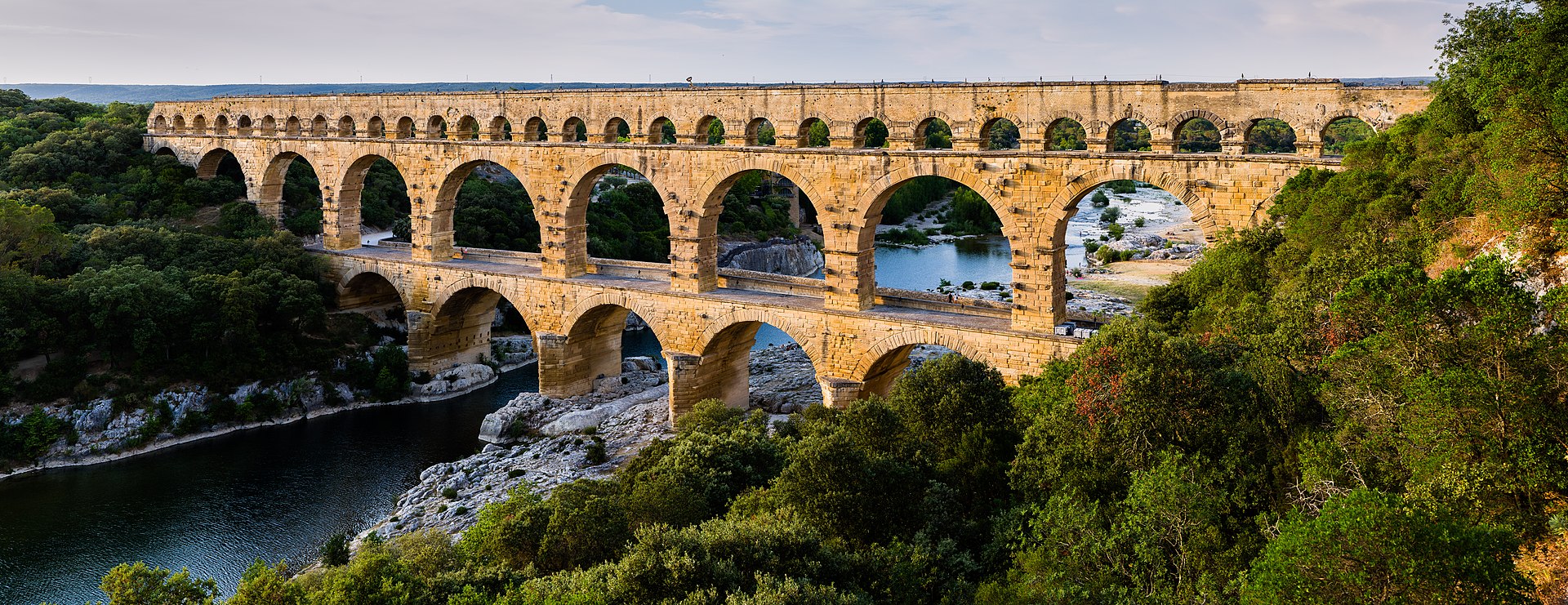
Pont du Gard
On Tuesday, after our usual swim in the pool, we explored the beautifully preserved medieval town of Les Baux-de-Provence, built as a fortress on a rock overlooking the plains going all the way to the sea, at a cite inhabited by people as far back as 6000 years ago. We walked for about 45 minutes around the rock exploring Celtic remains and the wild plants. The city itself has a very fine museum of santons, terracotta hand-painted figures traditionally used in Provence in nativity scenes at Christmas.

From there we drove through the city of Arles to take a plunge in the Mediterranean Sea at Saintes-Maries-de-la-Mer. The road went through the natural reserve of the Camargue, a flat, swampy area famous for its white horses, of which we saw plenty. The sea was quite warm, I guess at least 22 C, and we watched the evening sun go under the water. On the way back we listened to our Three Musketeers and sang their songs from the afore-mentioned Russian film. Driving in the dark was quite an experience, as the roads are not illuminated in France as they are in Holland.

On Wednesday we started to feel the first blows of the powerful Mistral wind rushing into the Rhone valley from the mountains and plateaus of the North and North East. The wind is said to take away all clouds and dust, making the air extremely clear, which is what the impressionist painters loved so much about Provence.

After our regular swim in the pool, we decided to explore the Luberon mountains, east of Avignon. We visited the gorgeous medieval towns of Oppède-le-Vieux, Bonnieux, Roussillon with its ochre quarries and ochre colored houses, and Gordes, with beautiful views of the Mont Ventoux, an enormous lonely mountain of almost 2000 meters high, dominating the whole area, which I incidentally climbed by bike a few years ago.

Roussillon and Mont Ventoux in the background

On Thursday, the Mistral blew unabated, the sun was dazzling, but the air temperature dropped significantly. So we stayed at home, reading, learning the French language, enjoying the pool and the French cheese. In the late afternoon we walked to the city, wandered the old streets, and finished the evening off by eating a famous French duck (canard) in the only restaurant still open in town at the close of the tourist season.

In the restaurant we met our hosts and had a nice conversation with them in their broken English and our broken French. They were very kind to offer to drive us home, as it got really dark and the wind was still blowing. Their house is right next to our residence and they have fishes and turtles, and the lady of the house paints santons (the Christmas figures I mentioned above), and they are generally very nice people! Joseph & Brigitte, our heartfelt thanks to you!

My experience was that the people in Provence, at least in the countryside, are very relaxed and helpful. There is no rush, and la vie est belle!

On Friday, yes, after the swimming pool, we drove to explore the area North of our town, visiting Saint-Laurent-des-Arbres, Laudun l'Ardoise, and a well preserved medieval castle of Chateau de Gicon on a hill overlooking the rivers Rhone and Ceze, which took us about an hour to climb on foot.

Chateau de Gicon
Friday evening we bathed in our swimming pool for the last time and packed. After a nice breakfast on Saturday morning we left, taking a slightly different route via Bourg-en-Bresse and Vesoul. We spent the night in Nancy, and in the morning explored this beautiful capital of the Dukes of Lorraine, with its Ducal Palace, the old gates La Porte de la Craffe, the Grande Rue street and the marvelous Place Stanislas and Stanislas Palace. Then we drove through the amazingly green and hilly countryside of Luxembourg and then via Liege and Maastricht back home!

This was a very fine, relaxed holiday with historic, culinary, nature and swimming highlights! Also I got inspired to learn French, which I have been doing now for a couple of weeks: Je m'appelle Leonid. J'habite à La Haye, à Pays Bas. Je suis informaticien. J'aime les chats, les pommes, les baguettes, le confiture et le chocolat. Ma femme s'appelle Luda et ma fille s'appelle Anne Sophie. Elles sont très belles! Nous avons une chatte, Kissy. À bientôt!

Accountability Report October 2014

As I wrote in my previous post, for a couple of months now I've been working daily on developing a number of habits to help me live a productive and meaningful life I so much want. In October, in addition to early rising, meditation and diary writing, which have become an indispensable part of my daily routine, I tried to focus on the habit of mindful productivity, which consists in spending 10 minutes each day writing down my 3 Most Important Tasks for the day and focusing on my true intention regarding these tasks.

Well, the habit didn't work out as I wanted. I skipped a few days, and then we were on holiday in Provence, Southern France, which was a wonderful experience, but completely disrupted my habits :)

According to my records, I just did a few mindful productivity sessions in October, so there is nothing to boast about. On the other hand, I spent a lot of time with my family, rested well and got a lot of inspiration from travelling, which is great!

In November I'll keep working on mindful productivity and will add a new habit: mindful relationships (with Luda)!

Here are my stats for October:

Wake-up time (average): 06:30 a.m., way up from 05:24 in September

Sleeping time (average): 08:17 hours a day, again way up from 07:11 hours in September, which means I was sleeping a whole hour longer on an average day in October compared to September!

Diary: 13:45 hours, down from 16:25 hours in September

Meditation: 3:30 hours, way below the 10:50 hours in September :( In October, I did almost no body scan meditations that tend to be a lot longer than my sitting meditations. My October average is thus 7 minutes a day.

Work (net time): 106:40 hours, down from 156:15 in September. This is because of my holiday and a 3-day sick leave.

Family: 150:40 hours, which is a lot more than the 65:50 hours in September. Most of my time on holiday I logged as Family Time

Transportation (excluding driving to, in and from France): 13:45 hours, way less than the 24:53 hours in September.

Social media: 06:35, much less than 21:08 in September.

Reading (excl. reading on holiday): 07:55, down from 14:35 in September.

Friends: 24:55 as compared to 12:55 in September! This includes writing to friends, talking to them on the phone or via skype, meeting them in person, doing something for them.

House (working on and around the house): 28:00 hours

Community service (volunteering at school and with the neighborhood watch): 04:15 hours

Sport: 17:30 hours (down from 25:47 in September), including:
  • Biking: 182 km, 08:15 hours
  • Running: 31.2 km, 03:25 hours
  • Circuit training: 02:00
  • Soccer: 01:30

Saturday, October 4, 2014

Accountability Report September 2014

As of August, I have embarked on developing habits. My motivation is to live the life I want and love. In this I follow a plan developed by Leo Babauta in his blog Zen Habits and in his Sea Change program.

I've been following Leo's blog for many years and I finally decided to really start working systematically on my habits. In August, I started with a beginner's program, whereby each day I would just write down one Most Important Task for the day. This worked out quite nicely.

In September I was working on 3 habits simultaneously: early rising, meditation and diary writing. This also went quite fine. As a form of accountability, I was reporting my progress daily in my accountability group (all Russian speakers!) and on Facebook.

It’s time to make up a detailed summary. I can do this now, because my diary habit consisted of, among other things, logging how much time I was spending on various activities. So here we go:

Wake-up time (average): 05:24 hours
So on the average I was waking up between 5 and 5:30, which is good. For the next month, I’ll try to get the average below 5:15

Diary: 16:25 hours
On average this amounts to a bit more than 30 minutes per day. It looks like I spent one whole day (waking hours) on logging my activities and writing diary entries.

Meditation: 10:50
So, I meditated 20 minutes per day on average. My meditations consist of longer body scans (some 30 min) and shorter sitting meditations (5 to 20 minutes)

Some other stats:

Work (net time): 156:15
Family: 65:50
Sport: 25:47
- Biking: 281 km, 14 hours
- Running: 41 km, 5 hours
- Circuit training: 02:30
- Soccer: 7 hours
Transportation: 24:53
Social media: 21:08
Reading: 14:35
Friends: 12:55

It would be interesting to compare October’s results to those of September!

Sunday, March 31, 2013

Small Daily Changes

Just got inspired reading this blog post from Zen habbits: http://zenhabits.net/change

The idea is Nothing will really change in my life unless I make a daily change

So what will be my daily changes in the coming month of April? Here they are:
  1. Mediate at least 5 minutes in the morning
  2. Eat breakfast mindfully
  3. Exercise daily (walking, biking or gym)
  4. Some music daily with Anne Sophie & Luda: singing, guitar, dance, music
  5. 1 hour study for the HTML5/CSS/Javascript exam
  6. at least 10 minutes daily for finances and administration
Looks like a lot. Let's see if I can keep it up! Starting today March 31. I've created a Google Dosc spreadsheet to track my daily progress.

Just did a 5 minutes meditation to start off this experiment!

...


This was a great day!

Did two 5 minute meditations
Went for a 2-hour walk on the beach with Luda, AS, Lena & Vadim
Made the eierkoek dessert! Everyone liked it!
Met Elsan (an Italian-Indian guy)
Performed Pushkin's fairy tales (Lukomor'e & Fisherman and the golden fish) with Anne Sophie & Vadim
Meditated before going to bed
Read the first chapter of Secrets of JavaScript Ninja, great book on JavaScript from the creator of jQuery!
So on this first day of my 1-month experiment I accomplished 6 out of my 7 daily change activities! All except the mindful breakfast.

Saturday, August 18, 2012

Remembering 18 August 1941

On this tragic day 71 years ago more than 100 adult men of Lapichi were executed by the Nazis and the polizei. Among them were my great-grandfather Simche Levin and his eldest son Moisei Levin. The rest of the Jews of Lapichi, several hundred women, children and the elderly, including my great-grandmother Chaya Levin, her daughter Dasha and her 3 little sons, her daughter-in-law Fanya (Moisei's wife) and her 2 little boys, were murdered in April 1942. Their memory will forever live in my heart.

No photos of Simche or Moisei exist.

You can find more information on my web site http://www.levins.info

Sunday, July 15, 2012

Remembering Grandma Sonja and Grandpa Semyon

Today is my late maternal grandmother Sonja's birthday. It's good to remember her. She would have turned 98, but she died 6 years ago. To tell the truth, I was always a bit afraid of her. I probably thought she was too strict, or actually too distant. I always said "Вы" to her, never "ты" (respectful "you" instead of casual "you"). But at the same time, I liked to visit her, liked her dinners and her compotes. Of course, I came also to visit my Aunt Natasha and my dear cousin Zhenya, who lived together with grandma.

Aunt Natasha, grandma, my mother Lora Levina
15 July 1999, grandma's 85th birthday

me, grandma, my mother Lora Levina
15 July 1999, grandma's 85th birthday

As a kid, I was proud that she and her husband (my grandfather) Semyon were Communist Party members, the only party members in our family. Grandpa would tell me his war-time stories, how he, as an artillery officer, would go on reconnaissance missions with his men, and how they would have to hide somewhere for days and eat horse meat. Grandpa was the head of the department of Geodesy and Cartography at the Technological Institute in Minsk. He never completely recovered from his wounds sustained during the war and died in 1984 when I was 11 years old. I guess I was even more afraid of him than of my grandma.

Grandma didn't say much. She would read her newspapers or watch TV. She'd inquire about how things were going with me. But she wasn't the kind op person I'd turn to to talk about my inner life and things that were really important to me. She was a strong personality, highly respected by everybody. I heard the stories of how she, in her late 20's, struggled and worked hard in evacuation during the war with two half-starved small kids, how she'd spend most of her free time after the war to study and learn.

I liked the food that she cooked, especially the fruit compotes with dried apricots and raisins. This is one of my most vivid memories from childhood :) Another memory of her is how I would enter the backyard of their house and see her sitting on a bench with a neighbor, while my then small cousin Zhenya would be playing outside. And the characteristic smell in the hall of the house, and how in the last years of her life she could barely walk and would lie down on her sofa for hours and think her thoughts. She remained very clear-headed until the end.

Rest in peace, dear grandma.

Thursday, June 28, 2012

70 years ago on this day ...

... my grandfather Aron Levin was killed in action at the age of 34 while serving as a private in the Soviet Army at the Volkhov-Leningrad Front. I related what I know about grandfather Aron in my previous post about my father a few days ago. Since then I spoke to his niece and my aunt Sofiya Kozlova, who told me what she heard about him from her mother and Aron's sister Berta Levina. I learned from her that Aron was a playful boy who used to make and play jokes on other kids.

Aron Levin
Aron (left), his wife Hana, and his siblings Musya, Samuil and Berta Levin
Vitebsk, 8 September 1936

I also possess letters that Aron sent to his wife Dasha from the front line.

Aron Levin (born 1908) is said to have inherited his father's entrepreneurial skills. But his life was cut short at the age of 34 as he was killed in action on June 28, 1942, at the Leningrad-Volkhov Front after drafting into the Soviet Army as a private. He didn't know that his father Simkhe (68) and his elder brother Moishe (39) were executed by the German Wehrmacht (regular armed forces) in August 1941 together with some 60 other adult Jewish men of Lapichi. In August 1942 the rest of the Jewish population of Lapichi (mostly women and children) were executed by the Nazis and local collaborators. Among them were my father's grandmother Chaya (64), Moishe's wife Fanya (28) and her 2 sons Genya (4) and Zyama (1), my father's aunt Dasha (31) and her 3 sons Gerik (5), Roma (3) and Zyama (10m), and some other relatives.

Thursday, June 21, 2012

Tribute to My Father on His 75th Birthday

Tomorrow, 22 June 2012, my dear late father Moisei (Misha) Levin would have turned 75 years old. I remember, when I was a small kid I was thinking about the year 2000 and how I would be 27 years old and my father 63, and how we would go together to the main street of Minsk for the New Year 2000 celebrations. This never came to be, as my father died unexpectedly of a heart attack on March 28, 1993. He was only 55 years old, and I was 19 at the time.

My dad was a quiet, kind, pensive person. I remember he would often sit and look into the distance, oblivious to what was going on around him, thinking his thoughts. I remember how I, as a small boy, was climbing all over him, listening to his heartbeat, exploring his beard. He was rather short, rather full-bodied, not the kind of father to brag about to your school friends. But he had beautiful big eyes and beautiful long black eye-lashes (that both me and my sister and my daughter inherited from him).

But above all he was a decent man. He never complained, never shouted at us kids, never said bad things about people in their absence, was polite and considerate in his dealings with people, yet firm in following his principles.


My dad was born on June 22, 1937 in Vitebsk to Aron Levin and Hannah (Dasha) Pukhovich. His grandparents Simkhe and Chaya Levin lived in the small Jewish shtettl of Lapichi, some 100 km south of Minsk. Simkhe had an entrepreneurial spirit. In 1904 he went to work in New York City as a laborer for 2 years together with his two younger brothers, but came back to his family in Lapichi. Together with his wife they set up a small shop. Simkhe travelled around to buy agricultural produce from local peasants, he also set up a small candle manufacturing business and sold candles to churches. Simkhe and Chaya had 6 children: Moishe, Aron (my grandfather), Dasha, Bertha, Samuil and Musya. After the Russian revolution Simkhe and his family were declared lishenets, which meant that they couldn't vote, couldn't be employed by the government, couldn't receive higher and technical education and were subject to other restrictions.

My grandfather Aron Levin (born 1908) is said to have inherited his father's entrepreneurial skills. But his life was cut short at the age of 34 as he was killed in action in late June 1942 (almost exactly 70 years ago) at the Leningrad-Volkhov Front after drafting into the Soviet Army as a private. He didn't know that his father Simkhe (68) and his elder brother Moishe (39) were executed by the German Wehrmacht (regular armed forces) in August 1941 together with some 60 other adult Jewish men of Lapichi. In August 1942 the rest of the Jewish population of Lapichi (mostly women and children) were executed by the Nazis and local collaborators. Among them were my father's grandmother Chaya (64), Moishe's wife Fanya (28) and her 2 sons Genya (4) and Zyama (1), my father's aunt Dasha (31) and her 3 sons Gerik (5), Roma (3) and Zyama (10m), and some other relatives.

The Germans invaded Soviet Union on the day of my father's 4th birthday. They swept over large areas of Belorussia and Ukraine in a matter of days. My father and his younger sister Polina survived thanks to their aunt Musya (then 20 years old), who rushed to Vitebsk from the burning Minsk and persuaded Aron and Hannah to evacuate immediately to the East. Misha and Polina were the only children in our family who were born before the war and survived the war and the holocaust, their 11-month-old brother Solomon died of typhus in November 1942.

My father's maternal grandfather David Pukhovich was arrested by the NKVD secret service shortly before the war. He presumably died in custody, date and cause of death remain unknown.

My father's family returned to Minsk in 1944. His mother was trained to be a Yiddish (Jewish language) teacher before the war, but she couldn't find a job after the war as the teaching of Yiddish was effectively banned. She had to settle for a job as a shop assistant. My father's surviving aunts Bertha and Musya and uncle Samuil were supporting them in all possible ways.

He was a good student excelling in most subjects, but above all in math and physics. One of his former fellow students related to me that my father didn't have many friends at school because he was very serious and far ahead in his studies. Once he met my father just the day before an exam as my dad was going to the movies. When asked: how about the exam?, my father simply replied that he had already learned everything. According to this fellow student, my father was quite uncompromising at school and quite bold towards some teachers. He never participated in any official committees.

After school he applied to the prestigious MFTI (Moscow Institute of Physics and Technology). He had all the needed qualifications but was not admitted based on the application interview. He had to apply to the Technological Institute in Minsk, where he started his scientific work in Theoretical Mechanics. As a student he volunteered to the Virgin Land Campaign (Целина) in Kazachstan, where he contracted malaria and barely survived.

Apart from science he had a passion for music and played the violin in an amateur symphony orchestra. He married my mother Lora Barshay in 1964 and my sister Lena was born in 1965. By the time he was already a Candidate of Technical Sciences (degree equivalent to PhD) and was working on his Doctoral thesis, which he completed in 1973, the year that I was born. However he was not allowed to defend the thesis as the communist party committee of the Polytechnical Institute refused to give him a positive characteristic.

In the late 1970's he had a chance to emigrate to the United States, but he decided not to, probably out of fear of becoming a refusenick, fear of not being able to find a job and reluctance on the part of the rest of the family.

All this time he taught Theoretical Mechanics at the Belarusian Polytechnical Institute in Minsk, often teaching  some 20 hours a week. Although some students would laugh as he would introduce himself and his foreign-sounding Jewish name: Moisei Aronovich, I heard from many of his former students (some of whom were youth leaders at the summer camps that I went to) that they really liked him, because he was respectful and fair to them. My father once told me that the purpose of an oral exam (which was a common practice at the time) is not to show the student what he doesn't know, but to discover what he knows about the subject.

But his real passion was research, which he conducted mostly in his spare time behind his desk in our small 1-bedroom apartment. He wrote some 70 scientific articles, was awarded several patents, and wrote a book summarizing his research. He was one of the first scientists in Minsk to use computers (ALGOL and FORTRAN programming languages) for his research and calculations.

He eventually managed to defend his thesis in Leningrad in the late 1980's and to publish his monograph The theory of deformable wheel rolling with the prestigious Moscow "Science" publishing house. Yet all the troubles he had to go into undermined his health. He died abruptly in March 1993 at the age of 55. His Professorship Certificate came in by post after his death.

I owe a lot to my father. My interest in science, computers and foreign languages, which played probably the most significant part in my success in life, were due to a large extent to him, as I often went with him to his computer center, learned from him to program our micro-calculator, and we would often listen together to the BBC World Service in English on our short-wave receiver. He was also instrumental in helping me develop my musical abilities.

But to be frank, as a teenager I didn't pay much attention to my father. I was busy with my own life, my own growing up, my own interests, which is probably typical of that age. At times I was disrespectful. I was taking him for granted.

His death was a severe shock and left me with a profound sense of loss and guilt. I missed him badly. I missed his warm hands, his embrace, his presence. Those were difficult times with the Soviet Union having collapsed and new economic realities taking place. I lacked self-confidence. Who could I go to for advice, love, understanding? How was I to navigate the rough seas of life?

I lamented the fact that I was given so many opportunities while he with his talent for science was denied so many. It's so unfair that he couldn't realize many of his ideas and inventions, that he didn't live long enough to enjoy deserved retirement and rest, to watch his grandchildren grow.

Yet I believe that his legacy will live in his children and grandchildren and great-grandchildren. And I see it as my duty to pass on his memory and the memory of our forefathers to the future generations of our family.

P.S. For more information about the Levin family of Lapichi, please take a look at my website http://www.levins.info/

Monday, May 21, 2012

Kiting on the Beach

Yesterday late afternoon Anne Sophie and I went for our favourite walk through the dunes of Wassenaar to the beach north of The Hague/Scheveningen. It was about 5 o'clock, and most beach goers already left, as it started to cool down after the hot and stuffy day.

It takes us 15 minutes to drive to the Meijendel Farm and another 25-30 minutes to walk the 2km trail through the woods and dunes to the beach. It should of course take less time, but Anne Sophie likes running around  and playing all kinds of games that she makes up along the way. This time I was supposed to be a calf and she a goat kid :) And then she started to draw crosses on the path with a stick to warn people not to walk there. And then we would draw the letters of her name, one letter every 20 meters or so. And then we were throwing the ball forward and trying to get to the ball first. When you walk like that, time really flies.


From Kiting on the Beach of Meijendel!

The sun was shining and the dunes were majestic. We hardly ever met anyone along the way, except (what a coincidence) some of our good friends Nadya, Volodya and Sergey, who were returning from the beach! Anne Sophie took Volodya's hand, even though she hadn't seen him for a couple of years, and started telling him stories from her school life. (To tell the truth, I am amazed how she trusts people that she hardly knows. I think it's a fine quality, even if some people may find it dagerous.) Sergey told of their trip to Mont St. Michel in Normandy, France. On Friday, he and Nadya and another friend were driving on the motorway, and then they thought they'd go to Brugge in Belgium. They had nothing with them except money, not even a tooth brush. But they thought what the heck! When close to Brugge, they missed the exit and decided to go on to France. They got home late Saturday night. That's a real adventure!

Except for a couple of walkers, the beach was virtually empty when we got there. It was sunny, but there was a cool breeze from the sea. Because of the haze we could neither see The Hague in the south nor Katwijk in the north. It felt like we were on some distant stretch of beach away from civilization.

And then we assembled our first kite that we bought on Queen's Day this April for a couple of Euros. It is a simple but beautiful triangular kite in rainbow colors. It is easy to get and keep flying in the wind, but it doesn't give you much steering control. We were running up and down the beach for almost 2 hours, and I must say I fell in love with kiting! What an intense felling of joy and freedom! I hope to be back soon with a more professional kite!


The sea water was very cold, but we did play Anne Sophie's favourite game of running away from the waves! And we would also draw on the sand. We drew Anne Sophie's name in Dutch and Russian (Аннушка) and also the word "Papa".

And then we got hungry and it was time to go home. We walked back through the dunes, and after Anne Sophie scratched her ankle and got really tired I carried her the rest of the way on my back. On the way back we called on Roderick to borrow his extension ladder so that Luda can paint the window frames tomorrow :)

It was a beautiful evening, something to cherish and remember for a long time!


Saturday, May 19, 2012

School Camp and Free Olympic Games

Monday through Wednesday this week Anne Sophie went to her first school camp! And I went with her! We were both quite excited. She was excited about the camp, because she had no idea what it was. Anne Sophie at her age of 4 is the youngest child at her school, so I was excited about how she would cope for 3 days away from home and from mama. I was also looking forward to getting to better know other children, parents and facilitators from our school De Vrije Ruimte (a democratic school for natural learning).

The camp took place at a wonderful location in the woods outside Eindhoven. We were lucky to get a room for the two of us with a bunk bed, and Anne Sophie immediately claimed the upper bed, which she would climb up and down multiple times.

The camp theme was the Olympic Games, and the kids called it De Vrije Spelen (The Free Games) and designed a logo for the camp that combined the school logo with the Olympic Games logo. So you can imagine that we had 3 days of games and sports, interspersed with creative activities, a disco, a film, meals, camp fires, guitar playing and plenty of leisure time. The location had everything one needs for a sports weekend: footbal fields, basketball, volleyball and tennis courts, a big children's playground, and a huge open air climbing facility!

The sports instructors team (Karin, Willem, Bram & Tamara, all physical training students) did a great job facilitating the sports activities. They brought the whole inventory of ball, rackets, bats, sticks, ropes, and even a slack line! We played football, basketball, tennis, badminton, table tennis, cricket, hockey. There was also athletics (long and high jumping and running), and newspaper-running and sack-racing, and much more. Kids higher than 1.30m did the open air climbing parkours in the trees in the rain. There was so much to choose from, and there was so much freedom to do what you wanted or not do anything special! Anne Sophie was enjoying the camp so much during these 3 days that she hardly ever remembered her mama :)

Anne Sophie kept practicing her jumping and even got a gold medal in the age group of 4-5 years old :) Watch here the video:


It was fun watching how the kids played and interacted with each other. I really felt that education through freedom works. Everybody seemed so at ease and relaxed and accepted and accepting of other people. Everybody could be completely themselves!


I was also impressed by Anne Sophie, by how she interacted with other, often much older children, how she trusted her friends and would do things I wouldn't even imagine she could because of that trust, how brave she is talking to different people and even talking publicly in a large group setting. I am very happy we sent her to this very special, small and unconventional school!